
April 28, 2026, The Sunday of the Myrrh-bearing Women, the day after Olga’s burial
I awakened with sudden alertness: “Unabella,” my heart said. Quickly, gripped with fear, I went into the nursery. In the dark “nest” was an imperceptible Light, too bright for the human eye to see. Being human, I flipped on the light switch.
I picked up the small one from her crib—was she breathing? Barely. But she was peaceful. I laid her on the changing table. Her eyes were open as her belly ceased the motions that would keep her earthside. Her gaze drifted above my right shoulder. I could only feel what she could see. Angels were drawing aside the curtain.
I cannot express all that was contained in those moments, which may have been many or few (though that only matters to those of us left behind). But it was the first time I stood between the here and the place we like to think is farther away than it is. God had allowed me into that angel-filled place, and the impact of it blew a hole through the way I see the worlds. Unabella (“Beautiful One”) was the first baby I ever buried, given to my care after being abandoned by her mother while I was working in South Africa.
There are innumerable things being a midwife has taught me. One of them is to approach birth as holy ground. At birth, as at death, the veil opens again. Angels are there to open it—to turn a water creature into an air-breather. God is again present in the garden to breathe into man the Breath of Life. At least, this is the Edenic path of most innocents drawn from the womb.
Even in births that go “well,” the sting of death and rebirth still occurs. Labor is not merely the coming and going of muscle contractions—it is the creation of a mother, regardless of how many times she has given birth. And as the archetypal Mother teaches us, the love of a child opens us to the deepest sorrows. A body must physically open, but so must a soul. A soul that has said yes to becoming a safe harbor for another soul—that has agreed to the intertwining of soul and body that occurs in pregnancy. This is one of the deepest forms of love and therefore necessitates the greatest sacrifice. Love without sacrifice is not love, but a fictitious egoism.
I recently miscarried our seventh child. “Miscarriage” is a terrible term—it almost trivializes the loss and subtly blames the mother. Worse still is to say, “I lost my baby,” as though I had forgotten her at the park or simply failed to see where she went. Though socially less gentle, it feels truer to say plainly: my baby died. Let others feel awkward before the truth.
We named her Olga Cecilia, after two beautiful saints: St. Olga, the midwife recently reposed in Alaska, and St. Cecilia, the third-century martyr whose faith helped lay the foundations of Christianity. Their names mean “blessed” and “blind”—not blind in darkness, but in the manner of an oracle, filled instead with the vision of divine realities unhindered by earthly sight.
I did not feel the veil open when Olga passed away. With my midwife eyes, I saw what the ultrasound technician was not permitted to say: there was no cardiac activity. Because I am a midwife, I knew what the official report would say before it came—fetal demise. Because I am a mother, I clung to every shadow of hope. Perhaps my dates were wrong, maybe I saw the screen wrongly, maybe the technician was new….. So many maybes filled my heart that my midwife's mind entered into a quiet war with a mother's hope.
Yet beneath both hope and reason, I already knew the truth. Like Unabella twenty years earlier, my baby's heart had simply stopped beating. I trust the angels waited for my little one as faithfully as they had waited for Unabella.
Those who know me can attest that I am not particularly nostalgic, nor especially emotional in the stereotypically feminine way. I think that at a young age I came to believe my emotions were a weakness—or at least inefficient—perhaps a lesson learned from growing up among a clan of boys. Slowly, over time, I have been opened to my emotions. I cry more now, especially when I am alone, and particularly when I seek stillness in the early mornings the candle light flickering on our icons.
I make sense of my emotional landscape—rightly or wrongly—by imagining that the upper layers many people feel are mostly quiet in me. But the deeper layers are strong and dense. I feel them when my husband holds me, when my children touch me, when my mother laughs with me, and when the sorrows of life—mine or others’—require presence.
I think I can say with some certainty that I have shed more tears of grief for Olga than at any other time in my life. She passed from my body ten days ago—my shared body suddenly empty, my soul still unwinding from hers. A restlessness indescribable except to those who know such pain. Nothing tangible remains to remember her by, no object to hold. A suspension, as instinctive impulses still point toward motherhood, though their object is gone—simply gone. I find myself resting my hand over my belly and then, with embarrassment, moving it elsewhere. So many silent tears.
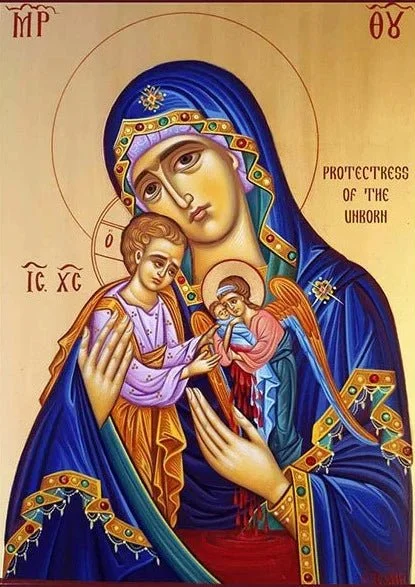
As I labored gently, though long, to bring forth Olga, the icon of the Mother of God, Helper in Childbirth, hung on the wall beside my bed. I looked to her in the same way I had during my full-term labors. The icon was a gift from my friend and Matushka, who knew pain and suffering all too well. She too was taken from this earth before reaching old age. I asked all three to pray for me. To ask the Theotokos felt natural. To ask Matushka Priscilla felt comforting. To ask Olga felt foreign—how could she be separated enough from me, her mother, to offer prayers on my behalf?
Tears—currents of them.
On our way to bury Olga Cecilia at St. John’s Monastery in Manton on April 25, 2026, only my oldest daughter rode with me. The first of my deep child-loves. She is one of the strongest women I know. We drove in silence. To my relief and surprise, she carried a presence that allowed me to process and feel without being alone—silent, strong, undemanding. We stopped occasionally and wordlessly gathered wildflowers for Olga’s grave. Tears slid quietly down my cheeks the entire way. Had I ever felt such pain? Such grief? How could my grief be so heavy? The answer became clear: it was not only mine.
I realized that the grief of mothers who lose a child rises like evaporation into a cloud layer. My own loss of Olga had pierced that layer—I was feeling the grief of all mothers: my close friend who suffered four miscarriages, my sister-friend who endured a stillbirth, my sister-in-law with her many losses, the women who never knew they were allowed to mourn their miscarried children, and others whose grief had been hidden away for years, believing they had no right to weep. Some grief is spoken aloud; some has been buried beneath fear, shame, or silence. Yet every mother who has lost a child bears a wound known fully by God.
This was why I felt called to grieve deeply—to grieve well—or risk limping into the shadowlands. This was the weight I carried, though it was not mine alone.
“Let the little children come unto Me, for of such is the Kingdom of Heaven.” My child, and the children of those I love who will never draw breath—of such is the Kingdom of Heaven. The priest’s words rushed over me: comfort, sorrow, pain, love—the manger, the cross, the empty tomb—LOVE. Not just for the child, but for the mother:
“Heal her suffering, and in Thy love for mankind grant health and strength to her body and soul. Guard her with a radiant Angel from every assault of the invisible demons and from every illness and malady, and deliver her from all that may afflict her womb. O Thou, Who accepts the innocence of infancy into Thy Kingdom, comfort the mind of Thy handmaid and bring her peace.”
My husband lowered Olga’s small coffin into an earthen grave beside other innocents - a tomb of darkness to be enlightened by the small body inside. They lie just east of the altar where I partook of the Resurrectional hope of the Liturgy the following day—the altar that is both tomb and hope, death and resurrection, the Light which casts out all darkness.
You cannot love without death. Every true act of love is a kind of self-emptying, a willingness to become vulnerable to another's suffering and your own. Paradoxically, this is the path to abundant life. The tomb and the womb stand nearer to one another than we dare believe and Reality is woven together with mysteries deeper than our eyes can see. May we not flee from the sorrows that love requires, nor harden ourselves against them. The wound of love is also the place where eternity quietly enters the world.
Olga Cecilia, pray for us.